Welded
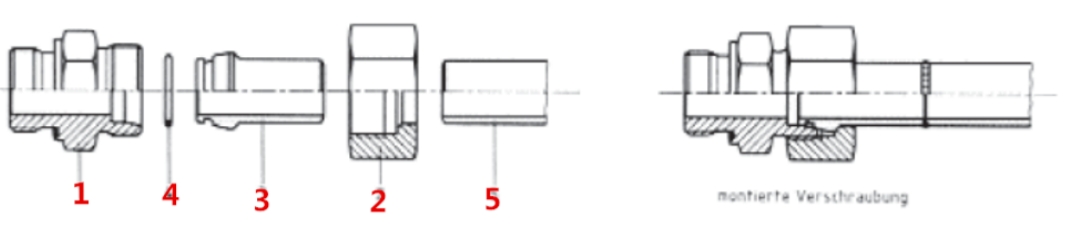
fittings use a connecting pipe to weld with the pipeline. An O-ring is
used for end-face sealing between the fitting body and the connecting
pipe. They feature a simple structure, easy manufacturing, and good
sealing performance, with low requirements on the dimensional accuracy
of the pipeline. However, they demand high welding quality and are
inconvenient to assemble and disassemble. The maximum working pressure
can reach 31.5MPa, and the working temperature ranges from -25℃ to 80℃.
They are suitable for pipeline systems using oil as the medium.
Cut the steel pipe vertically and prepare the groove in accordance with standards.
Slide Nut 2 onto Welding Head 3, then weld the welding head and Pipe
5 together as per standards. During welding, take care not to splash
weld beads into the pipe.
Clean the welded area and grind it if necessary. The connection
position must be clean and free of mechanical damage; use fine sandpaper
for cleaning when required.
Place the O-ring into the groove. The O-ring must be of the
appropriate size, with a slight gap between it and the groove wall, and
it should protrude approximately 0.4-0.6mm above the groove opening.
First, tighten the nut by hand, then further tighten it with an
appropriate torque. For reliability, use a solid wrench to hold the
fitting body in place.
Ensure the pipeline is properly fixed. Pipes with pre-installed
welding heads should be connected to the fitting body in a straight
manner to avoid bending stress. For pipes subject to dynamic loads, it
is recommended that the spacing between pipe clamps be 1.5-2.0 meters.
 English
 中文
中文